
Currencies are traded in dollar amounts called “lots”. One lot is equal to $1,000, which controls $100,000 in currency. This is what is known as the "margin". You can control $100,000 worth of currency for only 1,000 dollars. This is what is called “High Leverage”.
Currencies are always traded in pairs in the FOREX. The pairs have a unique notation that expresses what currencies are being traded. The symbol for a currency pair will always be in the form ABC/DEF. ABC/DEF is not a real currency pair, it is an example of a symbol for a currency pair. In this example ABC is the symbol for one countries currency and DEF is the symbol for another countries currency.
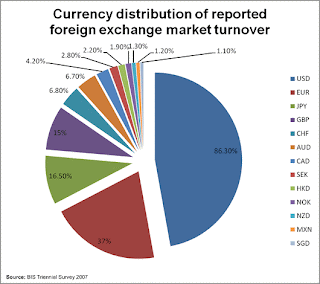
Here are some of the common symbols used in the Forex:
USD - The US Dollar
EUR - The currency of the European Union "EURO"
GBP - The British Pound
JPN - The Japanese Yen
CHF - The Swiss Franc
AUD - The Australian Dollar
CAD - The Canadian Dollar
There are symbols for other currencies as well, but these are the most commonly traded ones.
A currency can never be traded by itself. So you can not ever trade a EUR by itself. You always need to compare one currency with another currency to make a trade possible.
Currencies are always traded in pairs in the FOREX. The pairs have a unique notation that expresses what currencies are being traded. The symbol for a currency pair will always be in the form ABC/DEF. ABC/DEF is not a real currency pair, it is an example of a symbol for a currency pair. In this example ABC is the symbol for one countries currency and DEF is the symbol for another countries currency.
Here are some of the common symbols used in the Forex:
USD - The US Dollar
EUR - The currency of the European Union "EURO"
GBP - The British Pound
JPN - The Japanese Yen
CHF - The Swiss Franc
AUD - The Australian Dollar
CAD - The Canadian Dollar
There are symbols for other currencies as well, but these are the most commonly traded ones.
A currency can never be traded by itself. So you can not ever trade a EUR by itself. You always need to compare one currency with another currency to make a trade possible.


